Search engine optimization has evolved far beyond simply adding keywords to a webpage. Modern SEO involves technical improvements, strategic content planning, authority building, user experience, and continuous performance optimization. Businesses that follow a structured SEO strategy are more likely to achieve sustainable growth than those relying on random optimization efforts.
A well-planned 60-Day SEO Roadmap helps organize every stage of optimization into manageable milestones. Instead of trying to fix everything at once, this approach prioritizes the activities that have the greatest impact on search visibility and long-term organic traffic.
Whether you manage a business website, an eCommerce store, a SaaS platform, or a corporate website, following a structured roadmap allows you to build a stronger online presence while improving search engine rankings over time.

Why Does Every Website Need an SEO Roadmap?
Many website owners publish content regularly but fail to see measurable improvements in search rankings. In most cases, the issue is not content quantity but the absence of a clear optimization strategy.
An SEO roadmap acts as a blueprint that defines what needs to be completed, when it should be completed, and how every activity contributes to long-term growth.
Instead of making isolated improvements, a roadmap connects technical SEO, keyword research, content optimization, internal linking, and authority building into one consistent process.
Some of the key benefits include:
- Better crawlability and indexing
- Higher keyword rankings
- Improved website performance
- Stronger topical authority
- Increased organic traffic
- Better conversion opportunities
- Sustainable SEO growth
Rather than chasing quick wins, businesses following a structured SEO plan build long-term visibility that continues generating traffic even months after the initial optimization.
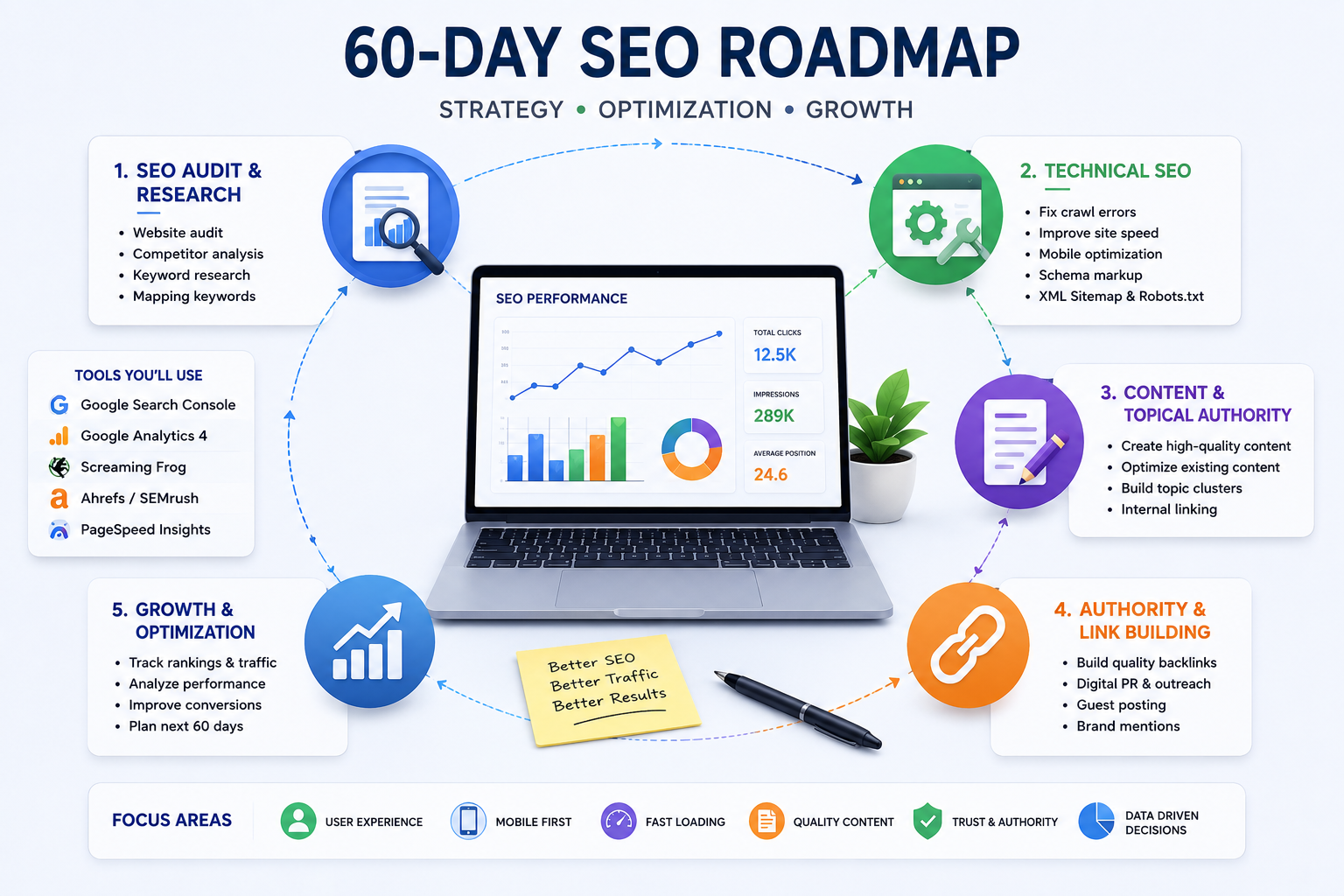
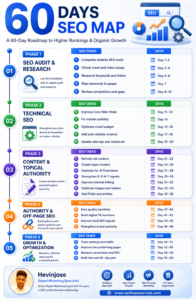
Phase 1: SEO Audit & Research (Day 1–10)
Every successful SEO campaign begins with understanding the current health of the website. Before implementing new strategies, it is essential to identify technical issues, content gaps, and opportunities for improvement.
What Should You Audit First?
Start by performing a comprehensive SEO audit to evaluate every major ranking factor. A professional SEO Audit Service can identify technical issues that affect your website’s search performance.
Areas to review include:
- Crawl errors
- Index coverage
- Broken links
- Duplicate content
- Page speed
- Mobile usability
- XML sitemap
- Robots.txt configuration
- Canonical tags
- HTTPS implementation
An SEO audit reveals hidden issues that may prevent search engines from crawling and indexing pages efficiently.
How Important Is Keyword Research?
Keyword research forms the foundation of every successful SEO strategy.
Instead of targeting only high-volume keywords, identify search terms that match user intent across different stages of the customer journey.
Consider searching for:
- Commercial keywords
- Transactional keywords
- Informational keywords
- Local search queries
- Long-tail keywords
- Question-based searches
Modern keyword research also includes understanding semantic relationships between topics, allowing search engines to recognize topical expertise rather than isolated keyword usage.
Mapping Keywords to the Right Pages
Once keywords are finalized, they should be assigned to the most relevant landing pages.
Avoid optimizing multiple pages for the same keyword because this may create keyword cannibalization.
A well-organized keyword map ensures every page has a unique search intent while supporting the overall website structure.
Why Competitor Analysis Matters?
Understanding competitor strategies helps identify opportunities that may otherwise be overlooked.
Analyze competing websites for:
- Ranking keywords
- Top-performing content
- Internal linking structure
- Content depth
- Backlink profile
- Page experience
- Featured snippets
- AI-generated search visibility
The objective is not to copy competitors but to identify areas where your website can provide greater value and better user experience.
Phase 2: Technical SEO Optimization (Day 11–20)
After completing research and planning, the next priority is strengthening the website’s technical foundation.
Technical SEO Services ensure search engines can efficiently crawl, understand, and index your content while improving overall website performance.
One of the most important tasks during this phase is improving Core Web Vitals, a key part of modern Technical SEO Services. Faster-loading pages reduce bounce rates, improve user satisfaction, and support better search visibility.
Mobile optimization should also be reviewed carefully since Google primarily evaluates websites using mobile-first indexing. Responsive layouts, readable fonts, touch-friendly navigation, and optimized images all contribute to a better mobile experience.
Another critical activity involves validating structured data. Proper schema markup helps search engines better understand page content and may improve eligibility for rich results such as FAQs, reviews, products, and business information.
Finally, ensure that XML sitemaps and robots.txt files are updated to guide search engine crawlers efficiently. These small technical improvements often have a significant impact on overall website health and indexability.
Phase 3: Content Optimization & Topical Authority (Day 21–36)
Once the technical foundation is in place, the next step is creating content that demonstrates expertise and satisfies user intent. Search engines increasingly evaluate how well a website covers a subject rather than simply counting keywords on a page.
Refreshing outdated content is often one of the fastest ways to improve visibility. Review existing articles, update statistics, add recent insights, improve readability, and include internal links to newer resources. Small updates can significantly improve rankings without publishing new pages.
Building topic clusters is another effective strategy. Instead of writing isolated blog posts, organize content around a central pillar page with supporting articles that answer related questions. This structure helps search engines understand your expertise and strengthens topical authority.
Modern SEO also extends beyond traditional search results. Optimizing content for AI Overviews, voice search, and conversational search engines requires clear answers, logical headings, concise paragraphs, and structured information. Adding FAQ sections, comparison tables, and step-by-step guides can increase the likelihood of appearing in AI-generated results.
Strengthening Experience, Expertise, Authoritativeness, and Trustworthiness (E-E-A-T) is equally important. Publish content written from practical experience, include author information, cite trustworthy sources where appropriate, and ensure your website clearly communicates its expertise.
Finally, improve internal linking by connecting related pages throughout your website. A thoughtful internal linking strategy distributes authority, improves navigation, and helps search engines discover valuable content more efficiently.
How Can AI SEO Improve Your Search Visibility?
Artificial intelligence is changing how people discover information online. Instead of relying solely on traditional search results, users increasingly interact with AI-powered search experiences that summarize information directly within search interfaces.
To improve visibility in AI-driven search:
- Write clear, conversational content.
- Answer common user questions directly.
- Structure articles with descriptive headings.
- Use bullet points where appropriate.
- Add schema markup to help search engines understand page context.
- Cover topics comprehensively rather than focusing on one exact keyword.
Websites that provide complete, trustworthy, and well-organized information are more likely to be referenced by AI-powered search experiences.
Phase 4: Authority Building & Off-Page SEO (Day 37–48)
Even the best content requires authority to compete in search results. During this phase, the focus shifts to increasing your website’s credibility through ethical off-page SEO practices.
Quality backlinks remain an important ranking signal. However, success today depends on relevance and trust rather than the number of links acquired. Earning mentions from reputable industry websites, business publications, and respected blogs provides stronger long-term value than low-quality link building.
Digital PR is another valuable strategy. Publishing expert insights, case studies, original research, or industry commentary can naturally attract citations and improve brand recognition.
Businesses targeting local customers should invest in Local SEO Services to improve visibility in location-based searches.
As your website gains authority, search engines become more confident in recommending your content for competitive searches.
What Should You Measure During an SEO Campaign?
SEO is an ongoing process, and regular measurement helps determine whether your strategy is producing meaningful results.
Instead of focusing only on keyword rankings, monitor metrics that reflect business growth, including:
- Organic traffic
- Click-through rate (CTR)
- Search impressions
- Conversion rate
- Qualified leads
- Goal completions
- Revenue generated from organic search
- Core Web Vitals
- Indexed pages
- Crawl errors
Tracking these indicators provides a more complete picture of SEO performance and highlights areas that require further optimization.
Phase 5: Growth & Continuous Optimization (Day 49–60)
The final stage of the roadmap focuses on refining your strategy based on real performance data.
Review pages with declining traffic or low engagement. Improve content quality, update outdated information, strengthen internal linking, and optimize metadata where necessary.
Combine SEO with Digital Marketing Services to improve conversions and maximize your return on investment. Sometimes small improvements to calls-to-action, page layout, or content structure can increase conversions without requiring additional traffic.
Finally, use the insights gained during the first sixty days to build the next optimization cycle. SEO is not a one-time project but a continuous process of improvement that adapts to changing search behavior, algorithm updates, and business goals.
Common SEO Mistakes to Avoid
Many businesses delay progress by making avoidable mistakes. Being aware of these issues can save time and improve long-term results.
Some common SEO mistakes include:
- Publishing content without keyword research.
- Ignoring technical SEO issues.
- Targeting multiple pages with the same keyword.
- Neglecting mobile usability.
- Building low-quality backlinks.
- Overusing keywords unnaturally.
- Failing to update older content.
- Ignoring search intent.
- Forgetting internal linking.
- Measuring rankings without tracking conversions.
Conclusion
A successful SEO strategy is built through consistent execution rather than isolated improvements. By following this 60-Day SEO Roadmap, businesses can systematically strengthen technical SEO, create valuable content, build authority, and measure meaningful results.
Every phase contributes to long-term organic growth, helping websites become more visible to search engines while delivering a better experience for users. Rather than viewing SEO as a one-time project, treat it as an ongoing investment that evolves alongside your business goals and changing search trends.
Whether you’re launching a new website or improving an existing one, a structured roadmap provides clarity, direction, and measurable progress. Start with the fundamentals, monitor your performance, and continue refining your strategy to achieve sustainable growth in organic search.


About The Author