Search is changing. But the answer isn’t just to publish more content in the wake of AI search.
A good SEO content roadmap is a bridge between what your audience is looking for, what your business can actually help with, and what search systems need to know.
At SEORANKE, we view an SEO content roadmap as a prioritization system, not a list of blog ideas.
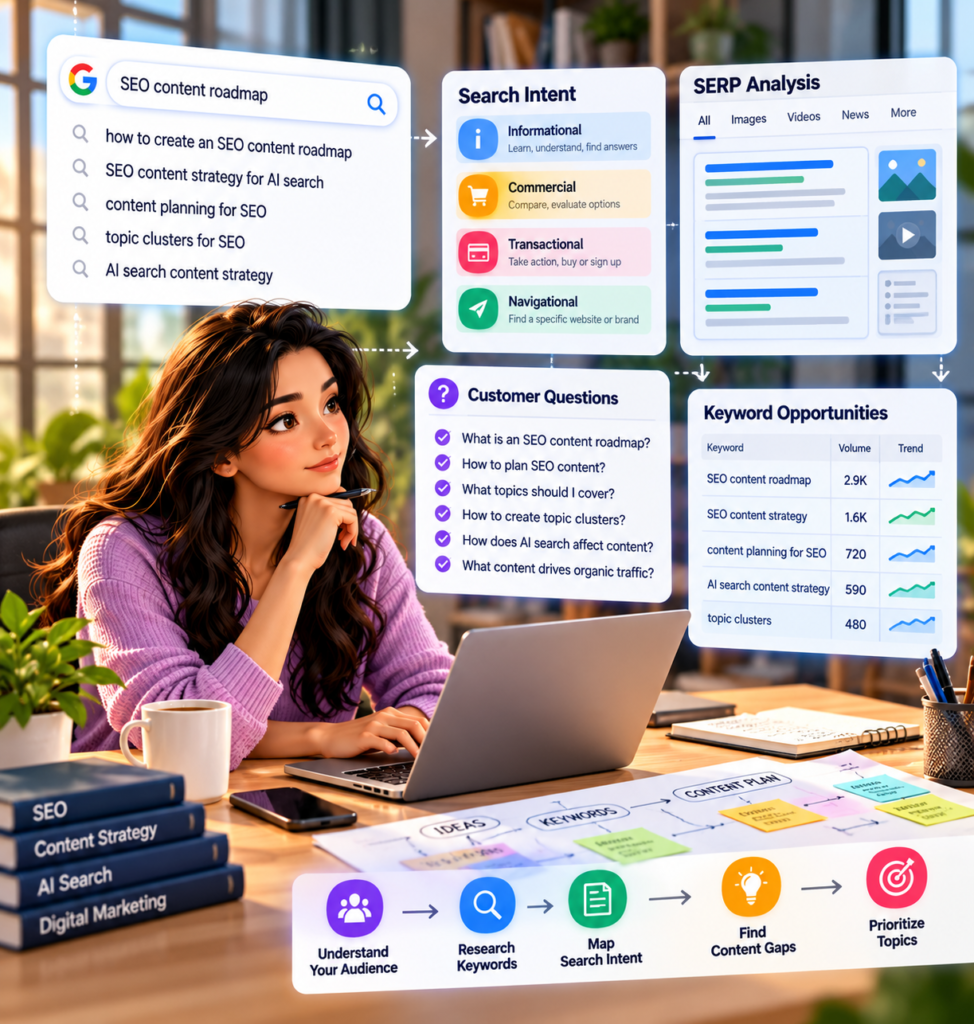
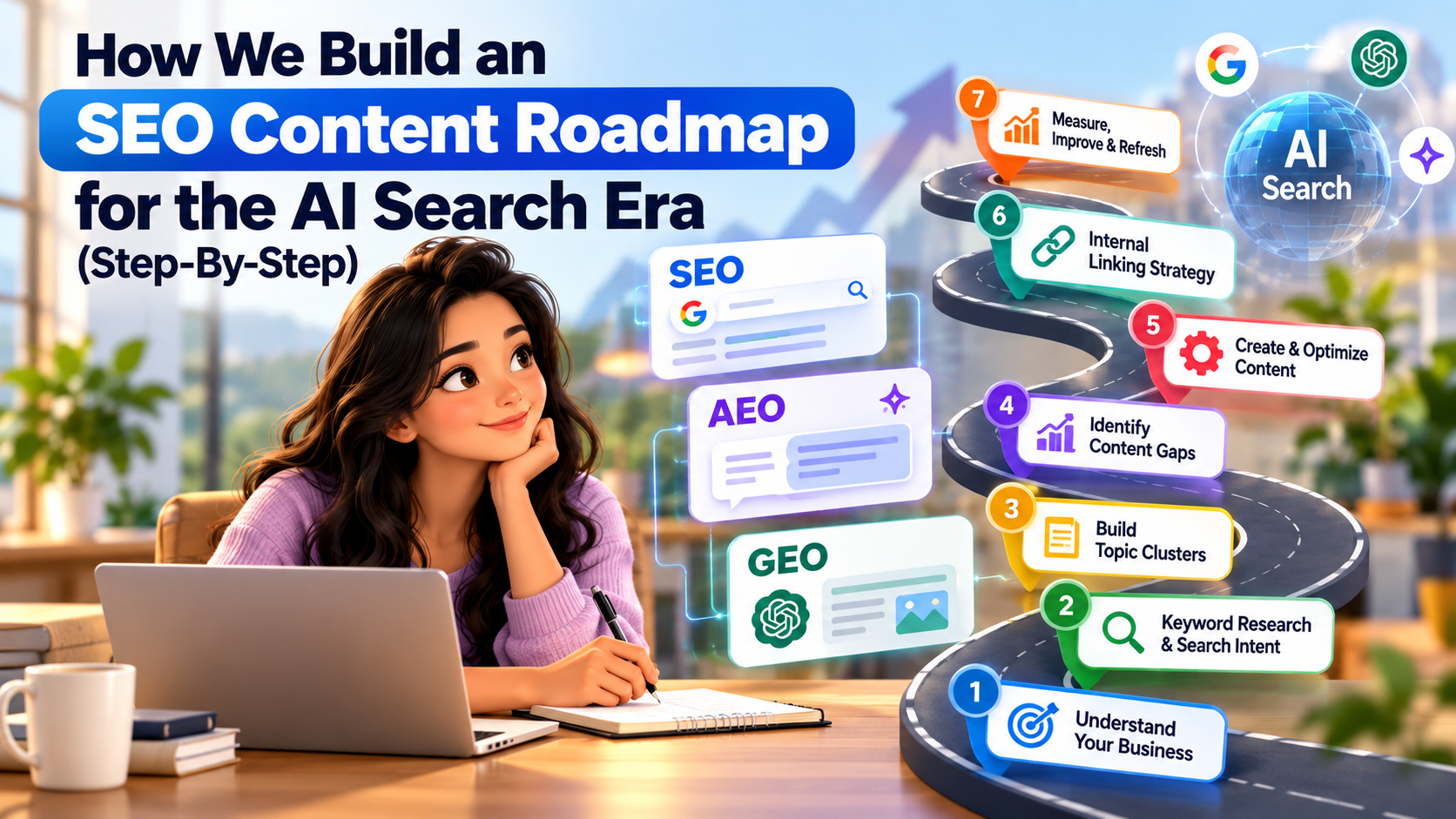
Here’s how it works, step by step.
Step 1: Understand the Business Before You Start Keyword Research
We begin with the business, not the keyword tool.
This way, we can avoid traffic that doesn’t relate to our business.
For example, an SEO agency might have a greater stake in content concerning technical SEO, local SEO, SEO audits, content strategy, and AI search optimization compared to more general topics like “digital marketing.”
The first question is straightforward:
What will the business believe in?
Step 2: Map out customer questions & search intent
Keywords are still important, but in the AI era a content roadmap requires more.
Searches are sorted by intent:
- Informational: The user wants to know about it.
- Commercial: Solutions comparison.
- Transactional: Ready to buy.
- Navigational: Users want to locate a specific brand or resource.
Then we map the relevant topics to actual customer questions.
We could map instead of only targeting SEO services:
- What Are SEO Services?
- What is the cost of SEO services?
- Is SEO Important for Small Businesses?
- SEO can take six months to a year to see significant results.
- What does AI mean for SEO?
The data approach gives you a roadmap in terms of the customer journey, not just a random list of keywords.

Step 3: Rank Topic Clusters According to Business Needs
Next, we cluster the opportunities into topics.
A pillar page is a page that covers a broad topic, with supporting articles that answer specific questions about that topic.
Here’s an example of a topic cluster from an SEO consultancy:
SEO Strategy → Technical SEO → On-Page SEO → Content Strategy → Local SEO → AEO → GEO → AI Search Optimization
This gives you topical depth and space for strategic internal links.
The goal is to have a library of connected, useful content.
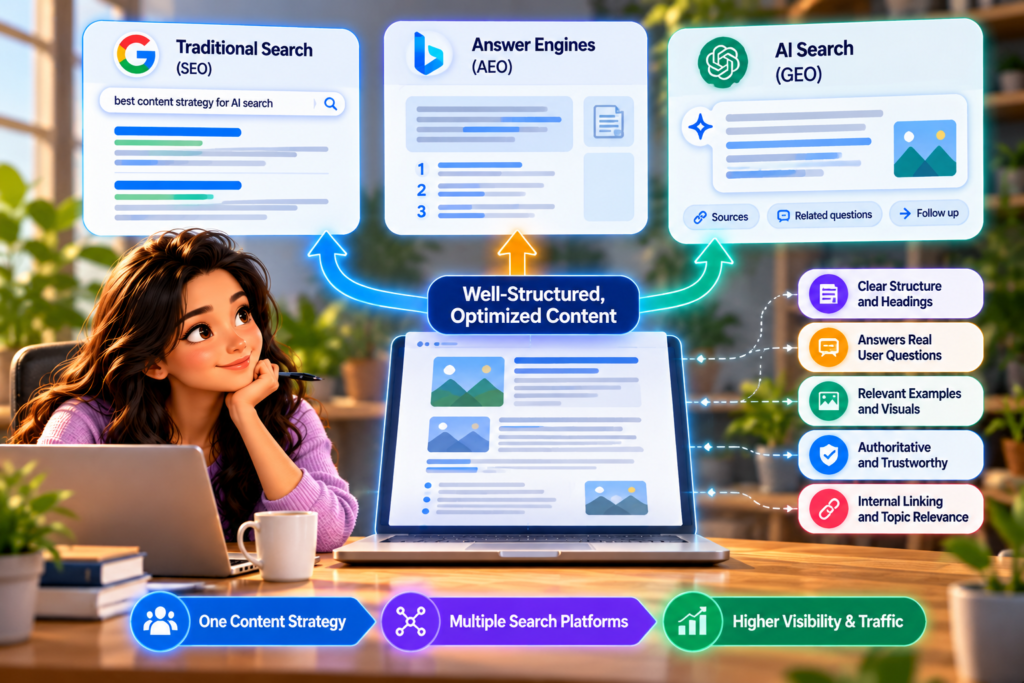
Step 4: Find Content Gaps and Opportunities
The generated topic map is then compared with the existing website.
Let’s find:
- Topics covered by competitors but not this site (Important)
- little or weak content questions from customers.
- Existing pages that need to be improved, not duplicated.
- Business areas where you have better knowledge than your competitors.
- Pages bringing in traffic but not converting.
That is where content gap analysis is useful.
Sometimes the best opportunity isn’t the keyword that gets the most volume. It’s a less common question, but it can be more valuable to have a high commercial relevance.
Step 5: Themes, Not Random Posts
A roadmap requires priorities.
Business value + search intent + relevance + content gap + competition + existing authority + effort
Then we rank topics into different categories.
High-priority topics are relevant to the business and have a real chance of delivery. Medium priority topics provide topical coverage. You can ignore topics with lower priority or push them back.
Step 6: Optimize content for humans and AI search
The AI search era doesn’t mean writing unnatural content for the machines.
So we make sure each page is easy to read:
- Yes, the statement is true.
- Use descriptive titles.
- Explain things in simple language.
- Add original examples and insights.
- back up key claims and, where appropriate
- Use images, data, or any other format that provides better understanding.
- Create an easy-to-use page.
The goal is content that works for the reader first but is also straightforward for search systems to interpret.

Step 7: Leverage Your Expertise
This approach is one of the most significant differences between regular content production and a solid SEO content strategy in the era of AI.
Articles that are just a rehash of what’s already on the web don’t bring much differentiation.
We are searching for opportunities to add:
- First-hand experience
- Original examples.
- Studies of cases
- Data or observations
- View of experts
- Practical procedures
- Lessons Learned from Actual Projects
Instead of another generic article on SEO audits, an agency could explain how it does an audit, what problems it typically finds, and how that plays into the SEO strategy. That gives the content a genuine reason to exist.
Step 8: Link Content to Internal Links
A roadmap shouldn’t just describe what we are publishing but how new content is connected to existing pages.
The supporting article may have a link to a pillar page. The pillar can link to supporting content. Educational articles can point to service pages, and relevant articles can point to services.
This helps to create a more coherent content ecosystem, rather than a collection of random blog posts.
Step 9: Translate the Strategy into a Publishing Roadmap
Now we have to turn the research into a concrete schedule.
A practical roadmap might include:
Topic → Search intent → Primary keyword → Secondary keywords → Content type → Priority → Target page → Internal links → CTA → Publish date → Update date
We also balance different kinds of content.
For example:
- Month 1: Fundamentals & Business Problems
- Month 2: Adding informational topics
- Month 3: Comparison, problem solving, and advanced topics
It’s better to be consistent than to try to publish an unrealistic amount.
Step 10: Measure, Improve, and Refresh
But publishing is not the end.
We monitor organic traffic, rankings, impressions, clicks, conversions, engagement, and key page performance.
We can also look at visibility in relevant generative search experiences for AI search and use the available Search Console reporting to understand how the site appears in Google’s generative AI features.
If a page is performing well, we look for ways to improve it.
When it doesn’t perform, we analyze whether it’s due to search intent, content quality, technical SEO, internal linking, authority, or something else.
What distinguishes an AI-era SEO content roadmap?
The most significant change is the move from
What keywords should we aim for?
to
What information does our audience need, and how can our business be a trusted source for it?
A modern roadmap combines keyword research, customer questions, search intent, topic clusters, content gaps, original expertise, internal linking, and performance data.
It also recognizes that search journeys can include traditional results, direct answers, and AI-powered experiences.
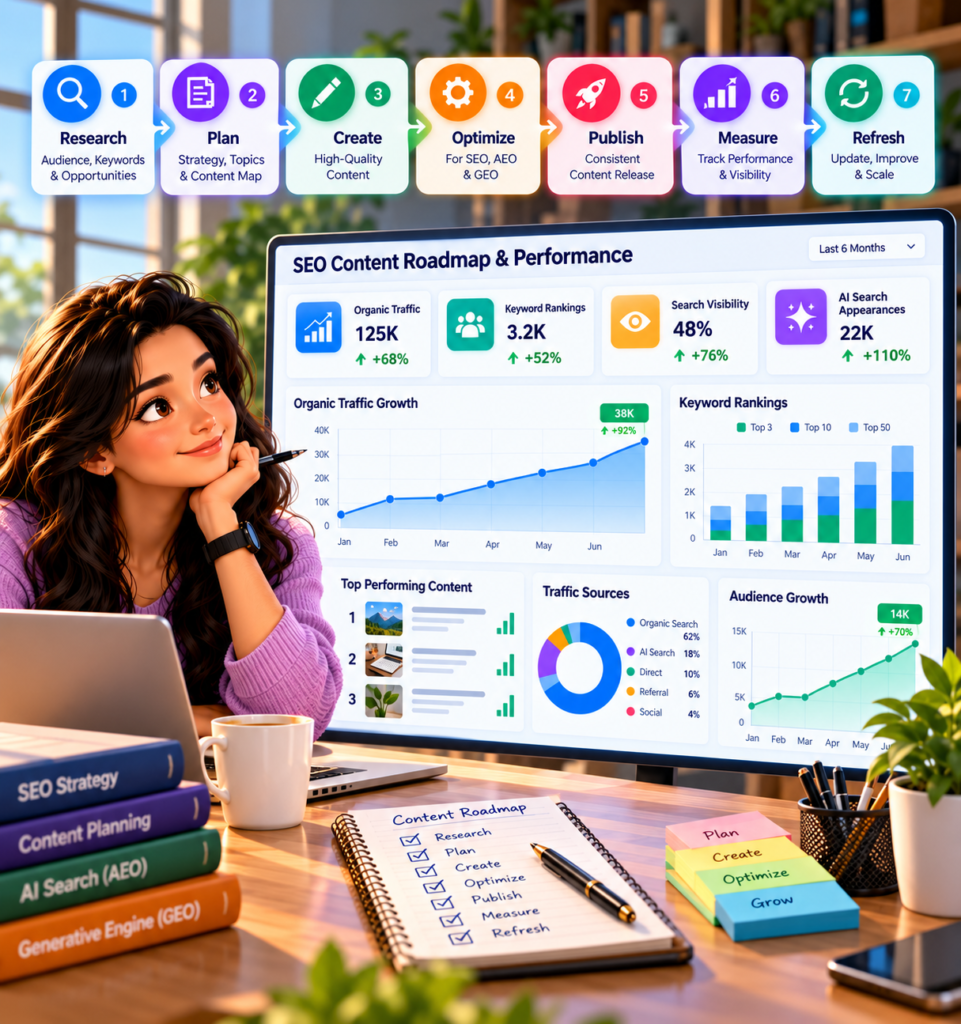
How SEORANKE creates SEO content roadmaps
At SEORANKE, we connect content to business goals, not just traffic for traffic’s sake.
We can help your business with keyword research, content gap analysis, topical strategy, SEO content planning, on-page optimization, and AI search optimization.
The goal is simple:
Create the right content, for the right audience, in the right order, and build a search presence that grows over time.
If your content strategy looks like a collection of random blog topics right now, it’s time to turn it into a real SEO content roadmap for the AI search era.


About The Author