Search is no longer just a list of blue links. Today, people are receiving information through traditional search results, direct answers, AI-generated summaries, and conversational search experiences. So for businesses, online visibility isn’t just about having a website.
In this changing environment, there are 3 terms that are becoming more and more important to know: SEO, AEO, and GEO.
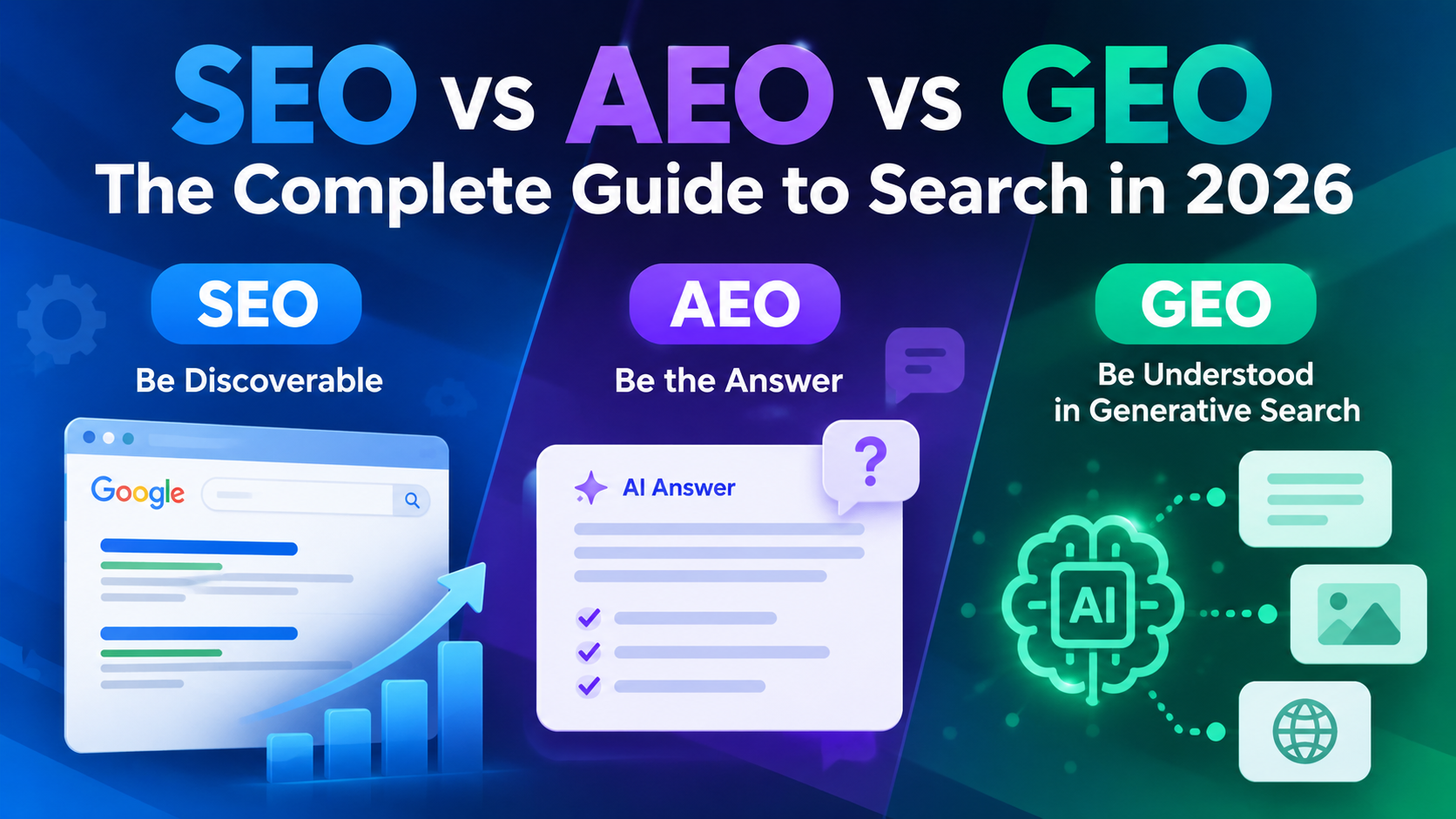
SEO is what helps search engines find and rank your website. AEO is about answering questions clearly for users. GEO is working to improve the understanding and representation of brands and content in generative AI search experiences.
Knowing the difference between SEO, AEO, and GEO can help businesses build a more effective search strategy for how people will search in 2026.
What is SEO?
Search Engine Optimization (SEO) is the process of optimizing a website so that search engines can crawl, understand, and rank the website’s content for relevant searches.
Effective SEO strategies can encompass technical SEO, keyword research, on-page optimization, content creation, internal linking, site architecture, local SEO, and authority building.
For example, a company that does digital marketing might create a page for “SEO services for small businesses.” Then potential customers searching for related services via SEO see that page.
The technical underpinnings matter too. Websites need to be findable by search engines, easy to navigate, mobile-friendly, and designed for useful content.
Simple language
SEO = greater exposure in the traditional search.
What is the AEO?
Answer Engine Optimization (AEO): Building content that makes answer-based search experiences easier to understand and navigate.
What’s the standard SEO question?
How this page is ranked for a query
Another important question posed by AEO is
How well does this page answer that question?
An AEO approach can incorporate question headings, short answers, definitions, FAQs, step-by-step explanations, and well-structured information.
A business can skip writing a general article about website audits and instead directly answer the question, “What does an SEO audit include?” and then develop the subject further.
AEO is particularly useful when users are looking for a particular answer, not a long list of sites.
So in layman’s terms:
AEO = Make your content the answer that helps.
What is GEO?
Generative Engine Optimization (GEO) is the process of optimizing a brand’s visibility and presence in generative AI search experiences. Now, users can ask conversational questions and get synthesized answers, instead of having to search through several pages. GEO measures how well a business demonstrates expertise and how easy the data is to understand in these environments.
Thus, GEO can be topical authority, original content, brand trustworthiness, entity clarity, relevant third-party references, consistent brand information, and content that directly answers user needs.
GEO is not just throwing around AI buzzwords. It’s a holistic way to make a business easier to understand, reference, and discover through AI-driven search.”
In simple English:
GEO = Help AI-Powered Search understand your expertise and brand.
For a deeper look at practical generative search strategies, see our guide to GEO strategies for boosting AI visibility.
SEO, AEO, or GEO: What’s the difference?
SEO, AEO, and GEO overlap somewhat, but each has different focuses on search visibility.
- SEO is organic search visibility. It’s about getting pages to rank and be found.
- AEO is about how you present information so it’s easy to read and extract and you answer questions cleanly.
- GEO’s mission is to provide visibility and representation for generative search and AI-based discovery.
A good way to keep the distinction clear is to:
SEO = Discoverable.
Be the solution. = AEO
Okay, so generative search is GEO.
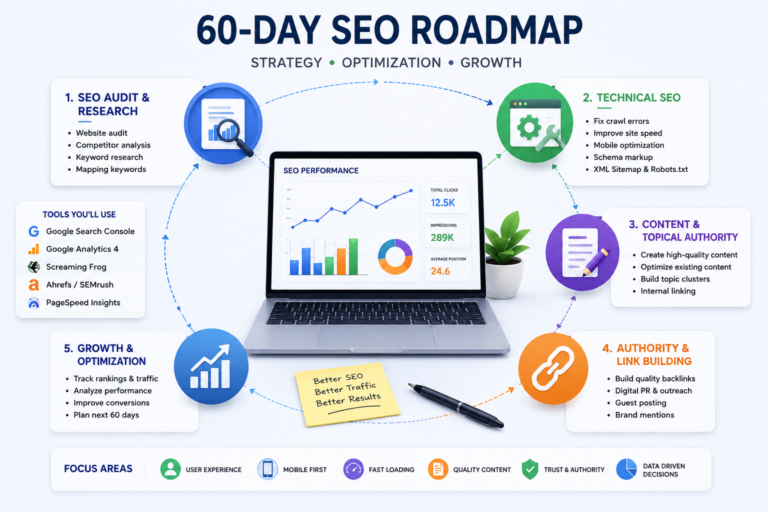
If you want a structured implementation plan, our 60-Day SEO Roadmap breaks SEO optimization into practical phases covering technical SEO, content, authority building and performance measurement.
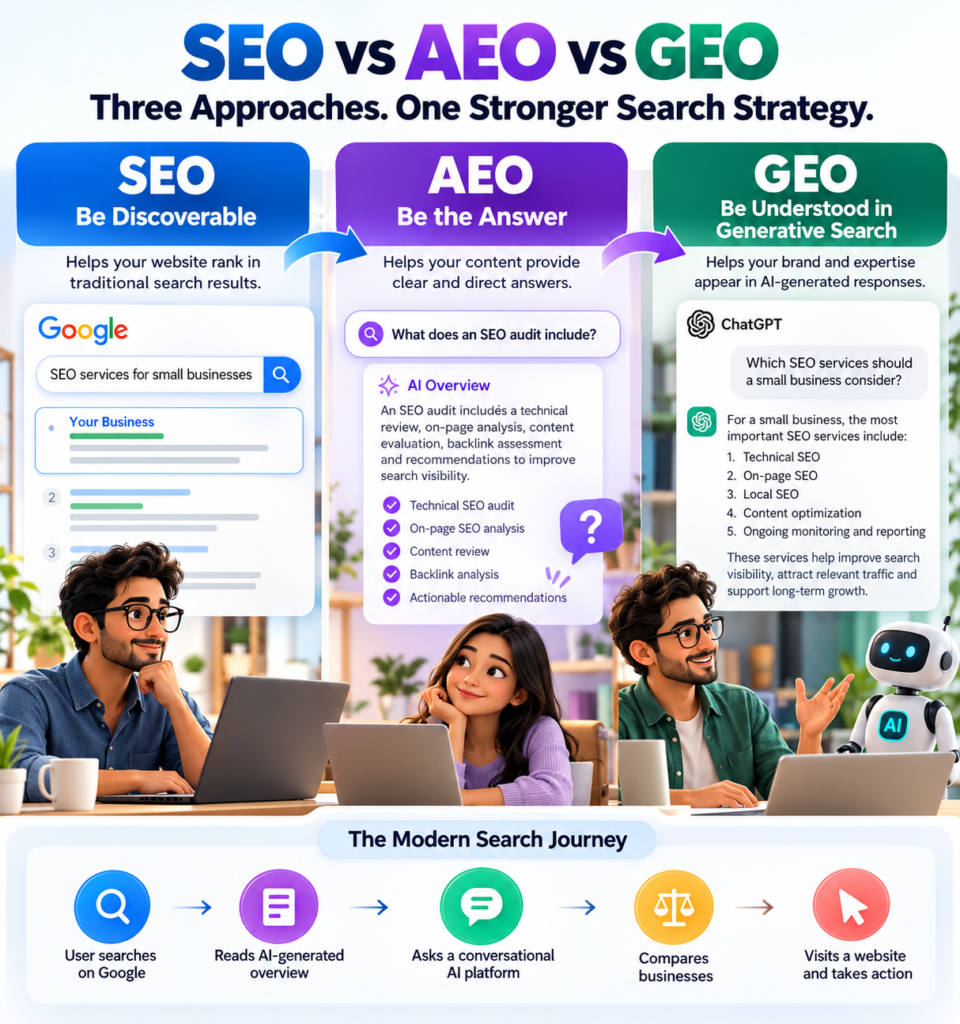
Three Search Strategies for a Single Business
To really get a sense of the difference between SEO, AEO, and GEO, let’s take a look at how one business might approach a topic.
Consider a small business that needs help with digital marketing.
SEO Approach:
The business creates a service page that offers SEO services specifically for small businesses. The aim is to make the page relevant and findable for people who are searching for SEO services.
AEO Approach:
The business creates valuable content that answers:
“Small Business SEO Cost—How Much Should You Pay?”
The content is direct in its explanations, discussing pricing factors, providing examples, and answering related questions.
The goal is to answer a critical customer question in a clear way.
GEO Approach:
The business creates authoritative content on:
Need SEO services for a small business?
The content is not targeting one keyword but covers technical SEO, local SEO, content optimization, AEO, GEO, analytics, and other relevant areas.
The aim is to display knowledge and context so that search and artificial intelligence systems understand the business and its subject matter.
The point is companies don’t need three entirely different strategies. SEO, AEO, and GEO can be combined search strategies.
Why SEO Alone May Not Be Sufficient
But in today’s world, the journey of a prospective customer in their search can involve many different experiences.
They might Google a problem, read an AI-generated summary, ask a conversational platform for alternatives, compare businesses, and finally visit a company website.
So that means that a brand can be there before someone clicks on an organic result.
That’s not to say that SEO isn’t relevant. Instead, it expands the idea of search visibility.
Businesses need to consider not only organic rankings but also answer visibility, brand visibility, and AI search visibility.
This is where the synergy of SEO strategy, AEO strategy, and GEO strategy can help greatly.
How to create an SEO, AEO, and GEO strategy?
1. Begin with Technical SEO
Before you start dumping loads of new content, ensure that search engines can see and understand your website.
Crawlability indexes site architecture, internal linking, mobile usability, redirects, canonical URLs, and structured data where appropriate.
A technically weak website can cheapen valuable content.
For additional practical SEO techniques covering audits, mobile optimization, internal linking and competitor research, see our guide to advanced SEO techniques.
2. Real customer questions analysis
A strong keyword research process helps identify search intent, customer questions, competitors and opportunities before creating content. Learn more about how to choose the right keywords for SEO.
For example, a company selling accounting software could be targeting not only “accounting software” but also
What are the advantages of accounting software for a small business?
What to Look for in an Accounting Program
Is Accounting Software Worth It?
This also leaves room for AEO and SEO opportunities.
3. Create answer-centered content
First, give your audience a quick answer, then elaborate.
Use descriptive headings, short introductions, helpful examples, FAQs, and a logical content structure.
Content can be scanned more easily, and search systems have a clearer structure of information.
4. Create Topical Authority
Writing one article will rarely make you an expert on a competitive subject.
Instead, build a pillar page that aggregates related articles on specific subtopics.
For example, an SEO consultancy could create a content cluster around:
Technical SEO → On-Page SEO → Local SEO → AEO → GEO → AI Search Optimization → Measuring SEO
A good internal link structure helps users (and search systems) understand how these topics relate to one another.
5. Show You Know The Score
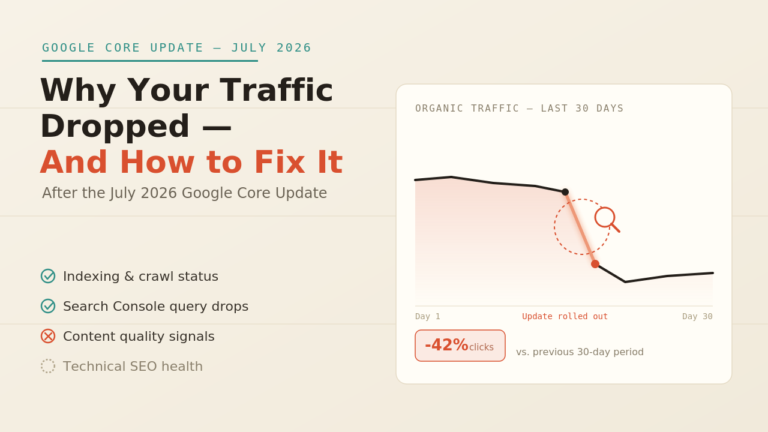
Keeping content updated is also important when search visibility changes. If your traffic has recently declined, our guide on the July 2026 Core Update explains how to diagnose ranking and visibility changes before making major changes.
Generic content is easy to create. Hands-on experience is harder to replicate.
Use unique examples, practical tips, everyday scenarios, academic studies, expert opinions, and clear explanations.
In fact, publishing tons of AI-generated generic content doesn’t make businesses considering GEO services or AI search optimization authoritative.
6. Build Brand and Entity Signals
Be clear about your business, what you do, and your strengths.
Make sure your website and any other relevant external websites consistently display important business information. Make credible references where applicable.
Clear brand information helps search engines and users know who you are.
What will AI Search mean for SEO services?
Modern SEO services shouldn’t be all about rankings.
Depending on what the business is trying to do, you can combine technical SEO, content optimization, AEO, and GEO into a larger strategy.
For some sites, technical SEO is the first thing to do. Others may require a more robust content architecture, answer-based pages, or a more general approach to AI search optimization.
The right mix is website, audience, competition, and search journey.
How SEORANKE Will Help You
SEORANKE helps companies create a search strategy that bridges the gap between traditional organic visibility and the new AI search landscape.
Services: On-Page SEO, Technical SEO, Content Strategy, AEO and GEO Focused Optimization, and Keyword Research.
The point is not to follow every new search fad. It is to develop a technically accessible, customer-useful, and clear about its expertise site.
A more comprehensive strategy provides a more solid base for search visibility in the long term for businesses looking at SEO services, AEO services, or GEO services.
The Future of Search Engines
It’s not so much about choosing SEO, AEO, or GEO, but about understanding the whole discovery journey.
SEO drives people to your site. AEO helps your content provide helpful answers. GEO examines how generative search experiences can find your brand and expertise.
Search is changing, and companies with a strong technical foundation, good content, topical authority, and clear brand information will be able to pivot.
Now the goal is not just to ask:
“How do I rank?”
A better question is
“How can my business be discovered, understood, and trusted wherever my customers search?”


About The Author